| |
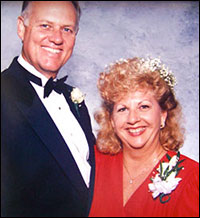
My name is Steve Mueller and I would have been married to my
lifelong sweetheart, Virginia (Ginny) for 42 years on Feb
22, 2012, had it not been for this awful, awful disease
called PSP that permanently interrupted our lives together.
After reading other stories online, I’ve decided to share
our experience of PSP. If my story will help just one person
the way those other stories have helped me, then it is worth
it. Our story began in our senior year of high school. Ginny
and I had known each other for years through school and
church youth group, but only as good friends. On that
Sunday, October 13, 1964, we kissed for the first time and
never stopped until January 11, 2012. It was the beginning
of a lifelong love affair which included graduation from
high school, Ginny attending college, and I entering the
Army. After those three years apart, we were reunited until
the end.
|
 |
| |
Along the way
we had a wonderful, full life together, having two sons that are
incredible in their own ways - different but very similar at the
same time. Ginny and I loved our boys - more than anything else
in the world. Both of our parents moved to Fort Lauderdale,
Florida in the early 1950’s. Ginny and I grew up there, went to
school there, and married on February 22, 1967 at the age 19. By
the time I was out of the Army, we had our first son, Steve ll,
so our busy lives were off and running. About two and a half
years later, we had our second son, Scott. Ginny did not take a
job until the boys were in high school so she could be home with
them and raise them correctly, which she certainly did! Before
we knew it, the boys were married and had families of their own.
Steve married a woman named Pam and they had two sons, Stephen
lll and Brandon, who are currently 18 and 16 years old. Scott
married a woman named Brooke and they had four children, Bailey
who is 6, Tyler who is 4, and twin girls, Alaina and Brenna, who
are 2.5 years old. After living in Fort Lauderdale for over 42
years, Ginny and I moved to North Carolina where we could see
mountains from our back deck. Ginny loved the mountains - this
was home. We both had good jobs and very active lives with our
families and church. Looking back on it, I’m able to realize
that things began to change as early as 2006. Ginny’s first
symptoms were fatigue and slowness of movement. At the time, I
thought she was just working too hard, etc. - the usual things.
As she began to worsen during the latter part of 2007 and into
2008, her work began to suffer and she could not keep up with
normal day-to-day routines. Looking back at the time, we thought
it was just the effects of working too hard and getting older.
By April 2008, Ginny’s hand movements began to get a little
shaky and her words became slurred. Ginny worked as an
administrator in a family practice doctor’s office - her boss
finally called her into the office and told her something was
wrong. Her boss had her see another doctor that afternoon, who
sent Ginny directly to a neurologist for a checkup. That was her
last day of work, in late April 2008 - our lives had now changed
forever. The neurologist ran several tests, concluded that Ginny
had Parkinson’s disease, and referred her to a big name
neurologist, saying that if anyone could help her, this new
neurologist could. We made an appointment to see the big name
neurologist. He ran several tests and concluded that Ginny had
multiple sclerosis (MS). We were totally confused and
frustrated. We didn’t know what to do but knew that Ginny was
not getting any better. The doctor started Ginny on a daily shot
program and exercise routine that were supposed to slow down the
progression of her symptoms, but as many of us now know, nothing
slows down progressive supranuclear palsy (PSP). We continued
down this path for approximately 8 months with no results.
Ginny’s fatigue worsened and she had to resort to using a walker
to get around. We decided to get a second opinion at Duke
University. Two visits and a great deal of expense later, the
Duke neurologist called her a “mystery woman.” He had no idea
what she had and actually told her she was nothing but a “lump”
- no activity. I should have punched him out. We left with more
frustration and no answers. We continued with the MS treatments
but our two daughter-in-laws knew something wasn’t right. By
exploring internet resources, they came to suspect that Ginny
had the symptoms of PSP. The more we read about PSP online, the
more everything fit together. Armed with this new information,
we went back to the neurologists we were seeing. One of them
called in an associate who was an expert on PSP. He determined
Ginny had both PSP and MS! All this took months to get done so
you can imagine our frustration and anger over this doctor’s
incorrect diagnosis. This doctor gave us some fresh information,
but of course, it wasn’t good news. While one can continue
living with MS, PSP is always fatal. At the time, I could not
comprehend this, but now I know and realize what was happening.
Eventually, Ginny needed a full-time person to be with her to
help prevent any falls and I was still trying to work a
full-time job, so the Lord sent us a gift from heaven in the
form of neighbors who lived across the street - Laurie, a
retired radiation therapist having much experience in handling
handicapped people, and her husband, Greg, a physician’s
assistant at a local family practice. They were such a blessing
- Laurie took over Ginny’s care and all but moved in while I
worked so we could maintain our home. It was very difficult for
me to accept help from anyone - I wanted to take care of Ginny
myself and thought I could do it all, but I finally realized
that my family, friends (like Laurie), and church family had a
need themselves to help us and so it all grew together to one
common goal - caring for Ginny. Praise the Lord for family,
friends like Laurie and Greg, other neighbors, and church
family. By late 2010, I had to retire so I could stay home and
take full-time care of Ginny. She could not talk clearly and her
hand motions were quickly degrading. She could not walk and was
permanently confined to a wheelchair. Ginny had always loved to
fish, so I took her fishing in her wheelchair at a local pond
that had a wooden pier she could sit at. It soon became very
apparent that she could not even hold a rod and reel, much less
catch a fish – our frustration was humiliating. That was the end
of Ginny’s fishing career. We decided to take her to the
University of Louisville in Kentucky, where PSP is often
researched. In June of 2011, Pam, one of our daughter-in-laws,
Laurie, and I took Ginny on a road trip to Kentucky. What a
trip! We had already sent all her medical records to them so
they were expecting us. After a day’s worth of tests and
observation, they told us that Ginny definitely had severe PSP
and never had MS. Wow - what a revelation, but at least after
3-4 years, we finally knew for sure. They asked us if we would
consider donating Ginny’s brain to research - it would be
harvested at the funeral home. This realization was a lot to
handle for all of us. Ginny agreed - she wanted to donate all
her organs but only her brain was deemed suitable, due to the
specifics of the disease. At the time of the trip to Kentucky,
Ginny’s bladder was not working and was causing her to urinate
about every 30 minutes, so she wore a Foley catheter bag. After
the trip we went to see the urologist and talked about a
permanent Foley catheter. When the nurse first told me that I
was going to have to manage this, I freaked out. For me to
insert this “thing” into my wife’s “private parts” was over the
top. I had worked in an industrial warehouse for the last 45
years - what did I know about catheters?! But you know, I did it
and got pretty good at it, by God’s grace. By the last half of
2011, Ginny was failing fast. Her mobility was almost all but
gone. She could not talk or even use her hands at all. Our
living room became her hospital room so we could take care of
her around the clock. Hospice was called into our home in
October 2011 and that was a huge help. Having doctors, nurses,
and CNAs there to assist was a huge help. We made it to
Christmas 2011. The day after, I was trying to get her from her
wheelchair to the toilet and her knees gave out. I knew that
once this happened, I was no longer able to take care of her at
home. The thought of this was heart wrenching - I wanted to take
care of Ginny at home. I guess I had not really accepted the
fact that she was going to die soon, but I had to. The next day,
they transported Ginny to the hospice hospital, where she
lingered 15 days and passed away from pneumonia and heart
failure. PSP itself does not kill – it is the symptoms that do.
Now that the one year anniversary has passed, I feel I am well
on my way to whatever a new life may bring. I can only do this
because I know “my Gin” is in the arms of Jesus. If there is
anything positive I can say about PSP, it would be that does not
linger for many years like some other diseases. When we were in
the thick of it, time seems to go on forever, but looking back
she suffered for only 2 to 3 years. Ginny really had no pain -
just a total loss of all motor skills and bodily functions.
Every day of the last 2-3 years seemed to drag on forever due to
the frustrations, anger, and just not knowing what was really
going to happen. Hopefully, through this story and others like
it, people may find extra help and more insight into this
terrible disease.
|
|
|